How to scale AI across your company: four layers from personal chats to company standards
Individual prompt crafting makes people faster, but leaves company IP on personal laptops. Here is the four-layer architecture that scales AI across the business.
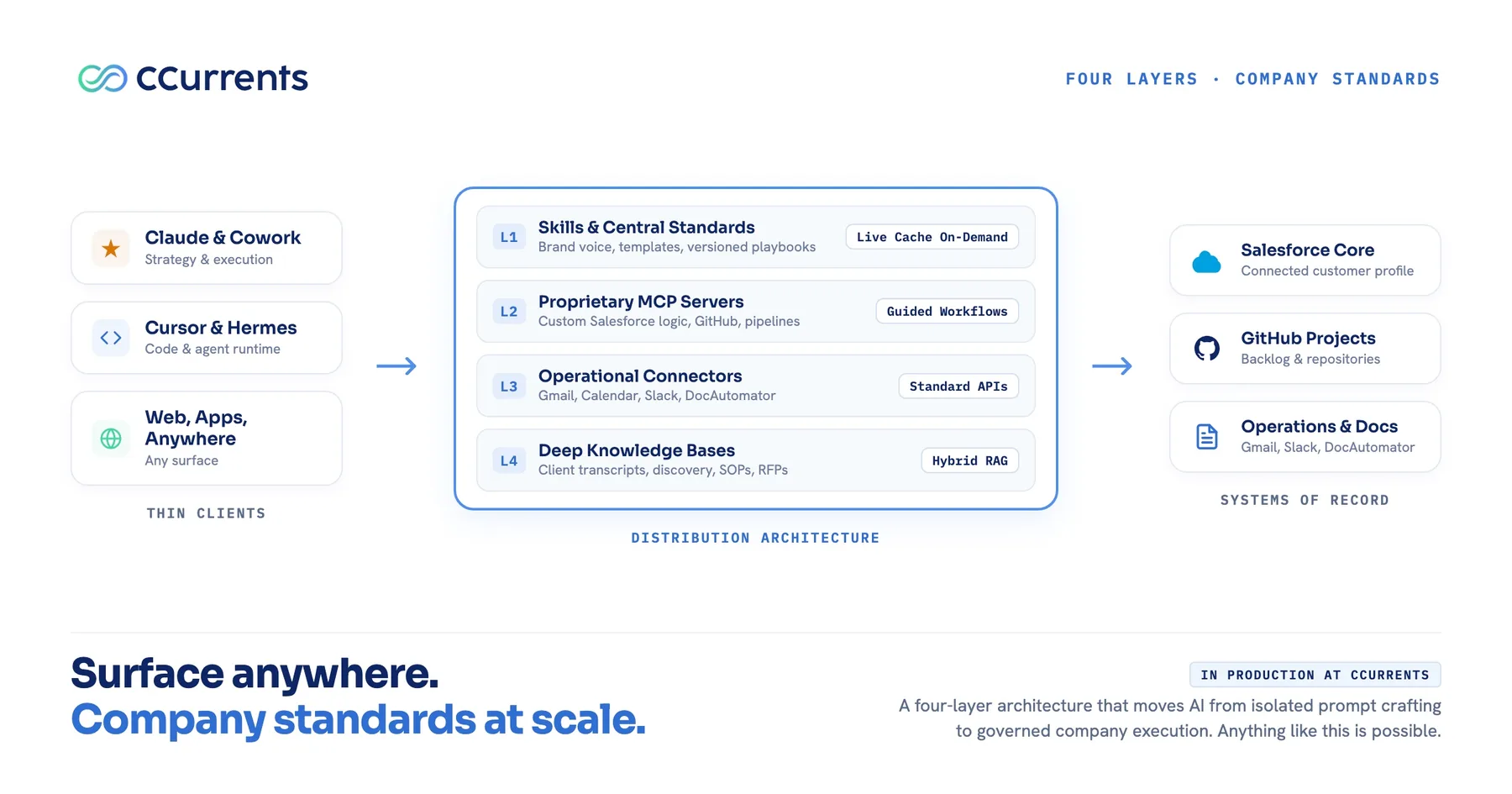
Your best operators, consultants, and engineers are already using AI every day. They craft sophisticated prompts in Claude Cowork and Cursor, shorten their turnaround times, and build private workflows that feel like superpowers.
From the outside, it looks like adoption. From the executive seat, it is an architectural bottleneck.
None of that speed belongs to the company. Every employee starts with an empty prompt window. Brand voice, proposal templates, and pricing logic get copied and pasted into private sessions. When a savvy operator develops an effective workflow, it stays on their laptop. When they leave, the capability leaves with them.
You do not have an AI-enabled company. You have isolated power users developing intellectual property on personal machines, with zero shared context, zero governance, and zero audit trail.
Moving beyond this requires an intentional shift: taking the standards, tools, and context people run on individual laptops and turning them into company-served standards that any thin client can access.
Why a distribution model matters
Why should leadership care about shifting from personal usage to a distributed architecture? Because spot adoption produces spot gains, but a distribution model compounds value across the entire business.
When you distribute AI through centralized architecture, you unlock four compounding advantages:
- Speed with quality. When an employee drafts a strategic memo or client proposal, they are not coaching an AI from scratch. The model starts with your company’s vetted standards, approved templates, and specific brand voice already loaded. Turnaround drops from hours to minutes without sacrificing executive polish.
- Shared intelligence. Instead of one senior partner or lead engineer knowing how to structure a complex deliverable, that institutional expertise is captured in a company standard. Junior and mid-level team members immediately produce work that reflects the judgment of your most experienced people.
- Trust and auditability. Unregulated chat sessions create anxiety: did the model hallucinate numbers, misquote pricing, or leak customer records? A distributed system executes defined workflows with verifiable receipts, citing the exact documents and systems it referenced.
- Tighter security and control. Individual sessions scatter customer data across unvetted tools. A centralized distribution architecture establishes strict guardrails around which models are used, where company data travels, and how systems of record are updated.
The companies that win with AI will not be the ones whose employees write the cleverest personal prompts. They will be the ones that build the infrastructure to distribute collective intelligence to every seat.
Four questions to assess your AI capabilities
How far along is your organization in developing true AI capabilities? Run this quick assessment against how your company operates today.
- The central standard test. When someone asks an AI to draft a client memo, slide deck, or proposal, does the model pull from a live, centralized company standard, or does every employee invent their own prompt?
- The system-of-record test. Can an AI assistant read or update live customer records in your CRM without a human acting as a manual copy-paste courier?
- The model governance and security test. Do you know which underlying models your employees call, what data passes to external endpoints, and whether those providers store your proprietary inputs?
- The push-upgrade test. When your brand guidelines, sales methodology, or compliance rules change, can you update the AI behavior for every team member in one central commit, or are you posting a Slack announcement asking everyone to update their prompts?
Most growth-stage companies fail three of the four. That is not a failure of talent; it is what happens when companies treat AI as a personal writing tool rather than an operating system.
The four-layer architecture for company-wide AI
Over the past few years at CCurrents, we moved our internal delivery from isolated prompt experiments in chat windows to a governed distribution model.
The goal was simple: any thin client (Claude, Cursor, Hermes, or a custom internal portal) should connect to the same centralized standards, governed tools, and institutional memory.
Here are the four layers that make that distribution work.
Layer 1: Skills and centralized standards (the playbooks)
Prompt engineering does not scale across an organization because individual prompts are brittle. When five different consultants prompt an LLM to “write a client proposal,” you receive five different structures, five different tones, and five different interpretations of your services.
In a governed architecture, procedural instructions are written as versioned markdown standards and stored in Git. Instead of requiring employees to maintain local copies of prompts, those standards are served through a centralized, live cache.
When a consultant or developer opens a session, their client fetches the standard on demand. When leadership refines a brand guideline, updates an SOW scaffold, or changes an audit procedure, that update is committed once to the central repository. The cache updates immediately. Every team member’s environment reflects the new standard in real time, with zero manual setup and zero local drift.
Layer 2: Proprietary MCPs (the governed hands)
Model Context Protocol (MCP) servers give an AI environment structured, programmatic tools to interact with systems. But not all tools should be off the shelf.
Generic connectors are built for basic utility: they retrieve and update records within standard user permissions. When an agent needs to execute company-controlled workflows, run a chain of business logic, or guide a user through a strict series of operational steps, you need a custom MCP built specifically for that purpose.
At CCurrents, custom MCPs govern our internal operations:
- Repository and project management. Our MCP tools connect to GitHub projects and issue boards, mapping customer requirements directly to user stories and release branches under strict git conventions.
- Guided CRM operations. Standard Salesforce connectors provide good but limited functionality: they simply read and write raw fields. We built a custom Salesforce MCP to handle multi-step, company-guided workflows. The agent can take a discovery call transcript, run custom validation logic, check required stage gates, establish parent-child relationships, and write clean records directly into the CRM in one structured sequence.
- Standard delivery. Instead of stuffing a 50-page brand guide or technical reference into the conversation, the local environment uses a lightweight MCP to fetch only the exact template or rule needed for the task at hand, keeping the context window fast and uncluttered.
A custom MCP turns a simple data connection into a guided operational process.
Layer 3: Operational connectors and general APIs (the execution utilities)
Not every tool requires custom engineering. Once proprietary workflows are governed by custom MCPs, general operational connectors handle day-to-day administrative plumbing.
These are standard API integrations into platforms like Gmail, Google Calendar, Slack, DocAutomator, or off-the-shelf connectors. Their job is straightforward execution: reading calendar availability, sending notification webhooks, or kicking off document rendering pipelines once an agent finishes drafting an artifact.
Separating Layer 2 (custom, guided workflows) from Layer 3 (general utilities) keeps your architecture maintainable. You do not write bespoke code to send an email or trigger a PDF build; you reserve custom engineering for the workflows that protect your revenue and your data.
Layer 4: Deep knowledge bases (the company brain)
The most common reason AI assistants hallucinate or produce generic work is missing context. But dumping all of your company documentation into an active chat window destroys speed and wastes tokens.
Deep knowledge bases solve The Documentation Debt by separating working memory from long-term institutional storage. Using hybrid search (combining dense vector retrieval with keyword search), an agent searches thousands of pages of historical documentation and retrieves only the exact paragraphs relevant to the immediate question.
What belongs in the deep knowledge base depends on your business:
- For client delivery and consulting: meeting transcripts, discovery notes, technical architecture decisions, and historical statements of work.
- For customer operations: past support ticket resolutions, return authorizations, and customer onboarding handoffs.
- For general enterprise: employee policy handbooks, SOC 2 compliance controls, vendor agreements, and past RFP responses.
When an employee asks, “How did we resolve this edge case for our healthcare client six months ago?”, the agent retrieves the exact decision record and cites the source, without an engineer spending two hours searching Google Drive.
The role of the architect: why infrastructure beats tool shopping
Buying seats for standalone AI tools is easy. Building the connective infrastructure that makes those tools safe, consistent, and cost-effective requires architecture.
A seasoned systems architect delivers three advantages that tool shopping never provides.
1. Order-of-magnitude cost control
Without centralized routing, teams run every minor query through expensive frontier reasoning models. A prompt that simply classifies an incoming email or summarizes meeting notes does not need an expensive flagship model.
By implementing a centralized routing gateway (such as OpenRouter or an internal proxy), an architect routes routine operational tasks to fast, hyper-efficient models like Google Gemini Flash. Frontier models like OpenAI GPT-4o or Anthropic Claude 3.5 Sonnet are reserved for complex system architecture, multi-step logic, and client-facing deliverables. This routing intelligence cuts inference costs by an order of magnitude across the enterprise.
2. Model governance and data security
Allowing individual employees to choose their own AI providers introduces major security and regulatory liabilities. Many widely discussed models have published security vulnerabilities, opaque data-retention policies, or foreign hosting infrastructure that violate basic customer privacy commitments.
Centralized architecture lets you establish a hard perimeter. You can mandate the use of enterprise-trusted, compliant models (such as Google Gemini, OpenAI GPT, and Anthropic Claude) while strictly blocking unvetted models that present data custody risks. Proprietary customer records and business IP never touch an endpoint your security team cannot verify.
3. Thin clients, persistent standards
When the four layers are in place, the end-user interface becomes a thin client. Whether an employee works in Claude Desktop, an IDE like Cursor, an agent runtime like Hermes, or an internal web dashboard, the behavior remains identical.
The user brings the interface they prefer. The company provides the governed standards, the operational tools, and the institutional memory.
See how we structure the revenue engine and architect governed AI tooling for growth-stage companies.
The short version
If you want to scale AI across your company without losing control of your IP, focus on architecture over subscriptions:
- Serve standards centrally. Move playbooks out of personal prompt libraries and into Git-backed, live-cached markdown standards.
- Build custom MCPs for sensitive workflows. Use purpose-built MCP servers to guide multi-step logic on systems like Salesforce and GitHub, while relying on standard connectors for routine administrative utilities.
- Separate working memory from deep storage. Deploy hybrid-retrieval knowledge bases so agents can access institutional history without clogging context windows.
- Govern the model layer. Route requests centrally to cut token costs by an order of magnitude and block unvetted model endpoints.
AnswersThe Documentation DebtThe Reporting NightmareTech Stack Sprawl